EXPLICIT STIMULUS EXAMPLE - WHISKER STIMULATION/THALAMIC NEURON
In the worksheet with analyze the stimulus effect and history effect on the firing of a thalamic neuron under a known stimulus consisting of whisker stimulation. Data from Demba Ba (demba@mit.edu)
Contents
Load the data
close all;
[~,~,explicitStimulusDir] = getPaperDataDirs();

Direction=3; Neuron=1; Stim=2;
datapath = fullfile(explicitStimulusDir,strcat('Dir', num2str(Direction)),...
    strcat('Neuron', num2str(Neuron)), strcat('Stim', num2str(Stim)));
data=load(fullfile(datapath,'trngdataBis.mat'));

time=0:.001:(length(data.t)-1)*.001;
stimData = data.t;
spikeTimes = time(data.y==1);

stim = Covariate(time,stimData,'Stimulus','time','s','V',{'stim'});
baseline = Covariate(time,ones(length(time),1),'Baseline','time','s','',...
    {'constant'});

nst = nspikeTrain(spikeTimes);
nspikeColl = nstColl(nst);
cc = CovColl({stim,baseline});
trial = Trial(nspikeColl,cc);
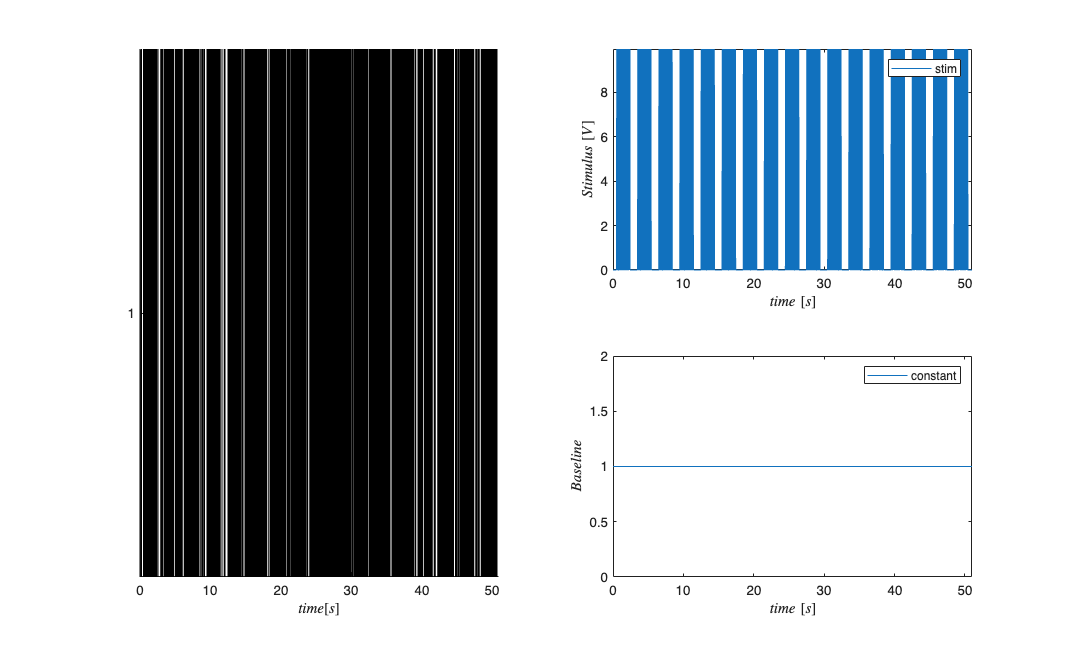
trial.plot;

figure;
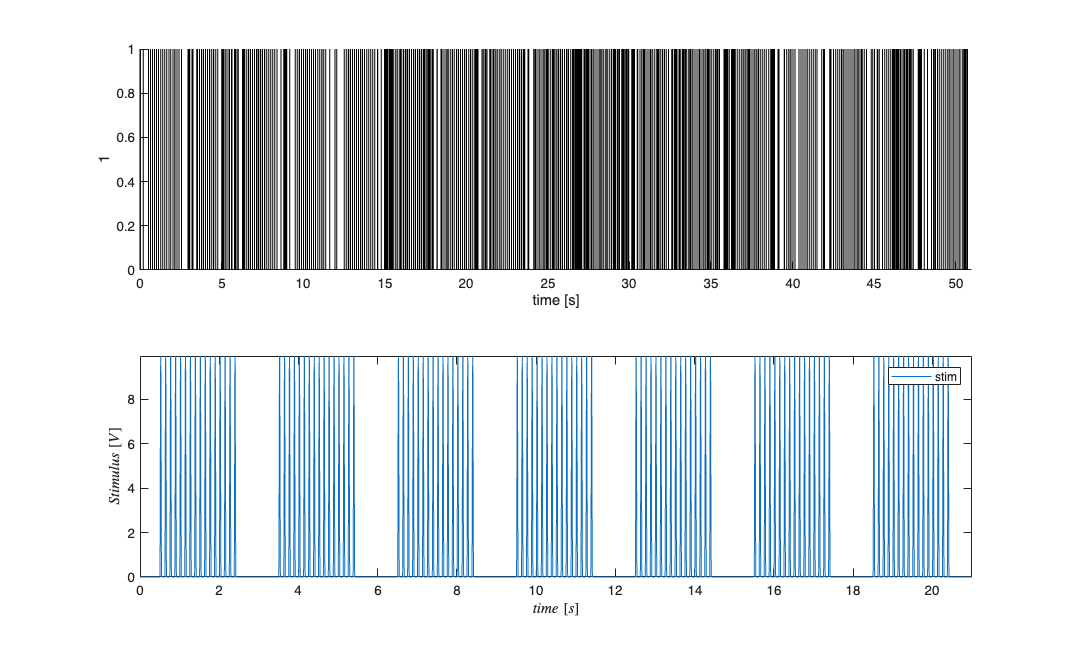
subplot(2,1,1);
nst2 = nspikeTrain(spikeTimes);
nst2.setMaxTime(21);nst.plot;
subplot(2,1,2);
stim.getSigInTimeWindow(0,21).plot;
Fit a constant baseline and Find Stimulus Lag
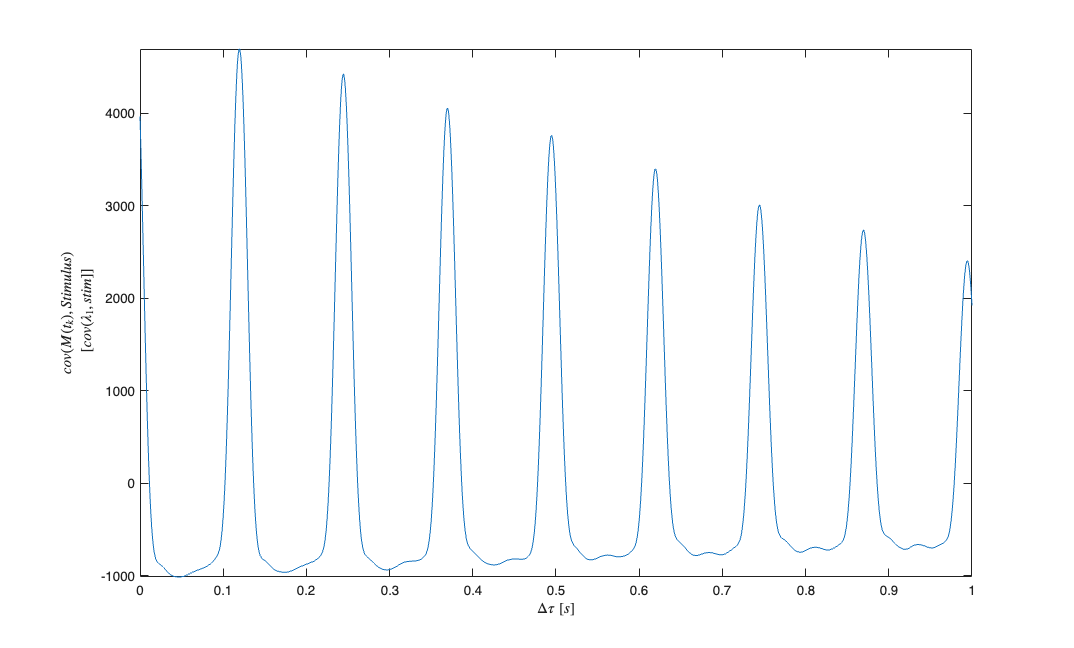
We fit a constant rate (Poisson) model to the data and use the fit residual to determine the appropriate lag for the stimulus.
clear c;
selfHist = [] ; NeighborHist = []; sampleRate = 1000;
c{1} = TrialConfig({{'Baseline','constant'}},sampleRate,selfHist,NeighborHist);
c{1}.setName('Baseline');
cfgColl= ConfigColl(c);
results = Analysis.RunAnalysisForAllNeurons(trial,cfgColl,0);

% Find Stimulus Lag (look for peaks in the cross-covariance function less
% than 1 second
figure;
results.Residual.xcov(stim).windowedSignal([0,1]).plot;
[m,ind,ShiftTime] = max(results.Residual.xcov(stim).windowedSignal([0,1]));
%Allow for shifts of less than 1 second
stim = Covariate(time,stimData,'Stimulus','time','s','V',{'stim'});
stim = stim.shift(ShiftTime);
baseline = Covariate(time,ones(length(time),1),'Baseline','time','s','',...
    {'constant'});

nst = nspikeTrain(spikeTimes);
nspikeColl = nstColl(nst);
cc = CovColl({stim,baseline});
trial = Trial(nspikeColl,cc);
Analyzing Configuration #1: Neuron #1
Compare constant rate model with model including stimulus effect
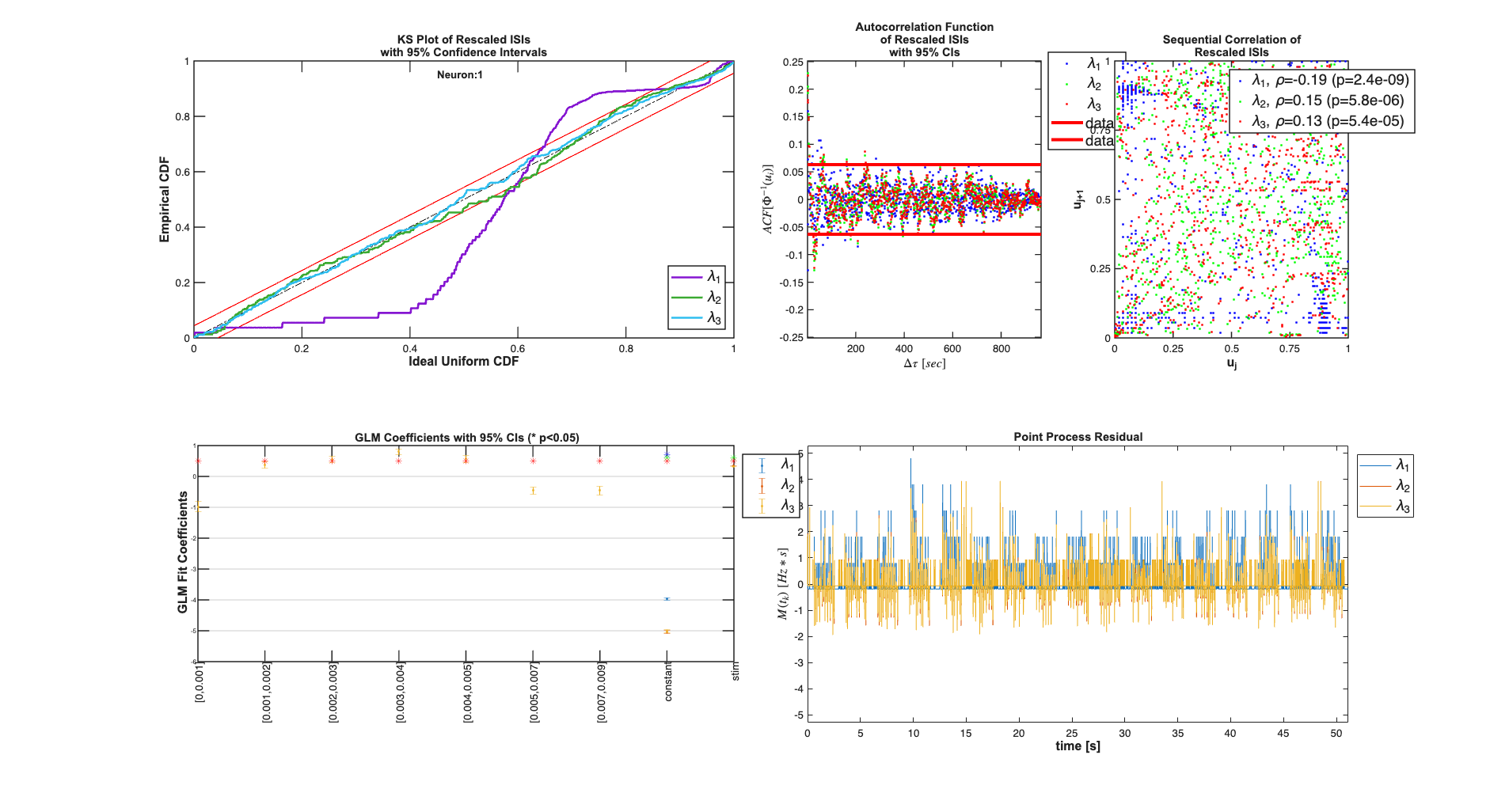
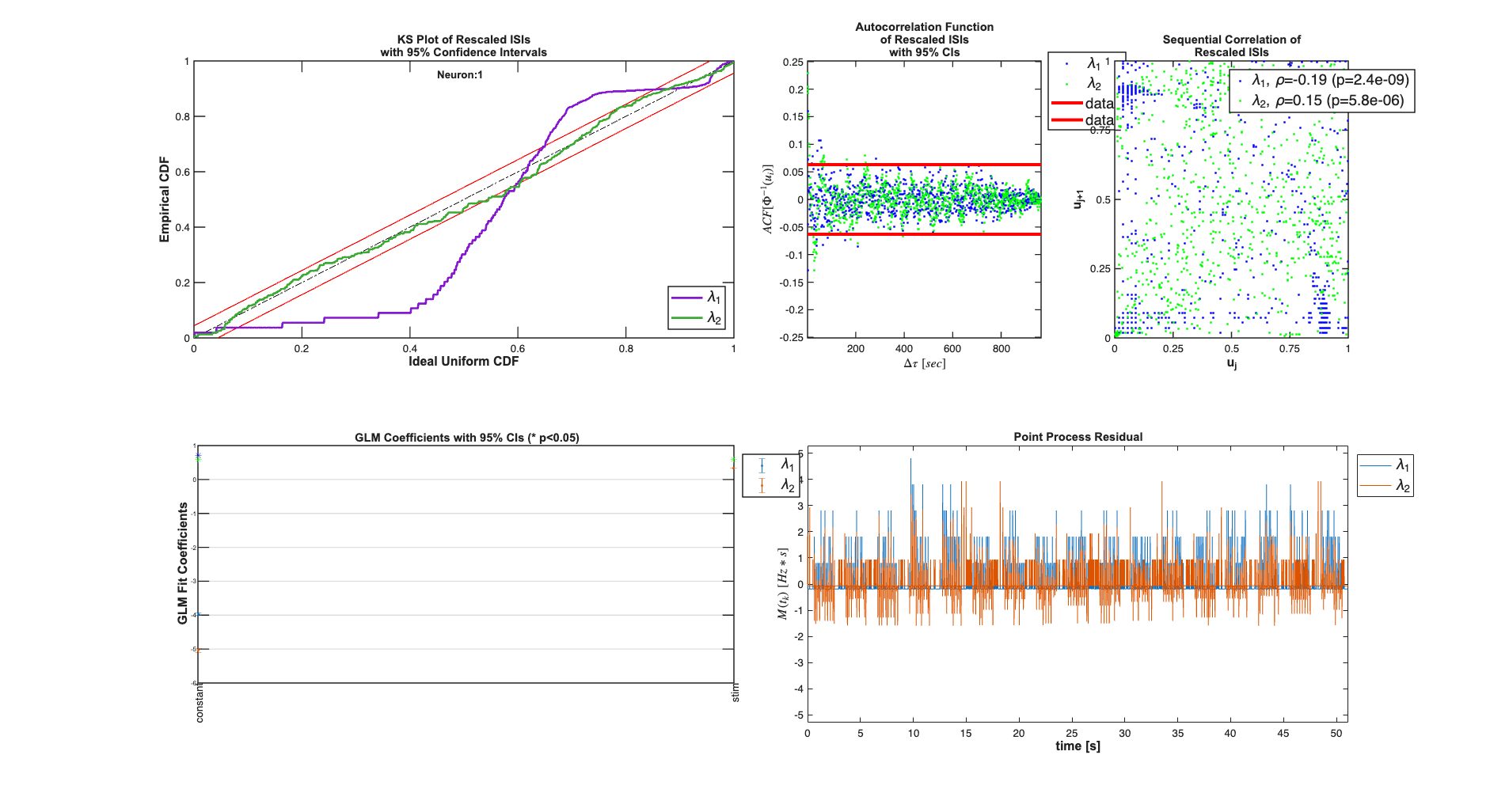
Addition of the stimulus improves the fits in terms of the KS plot and the making the rescaled ISIs less correlated. The Point Process Residula also looks more "white"
clear c;
selfHist = [] ; NeighborHist = []; sampleRate = 1000;
c{1} = TrialConfig({{'Baseline','constant'}},sampleRate,selfHist,...
    NeighborHist);
c{1}.setName('Baseline');
c{2} = TrialConfig({{'Baseline','constant'},{'Stimulus','stim'}},...
    sampleRate,selfHist,NeighborHist);
c{2}.setName('Baseline+Stimulus');
cfgColl= ConfigColl(c);
results = Analysis.RunAnalysisForAllNeurons(trial,cfgColl,0);
results.plotResults;
Analyzing Configuration #1: Neuron #1
Analyzing Configuration #2: Neuron #1
History Effect
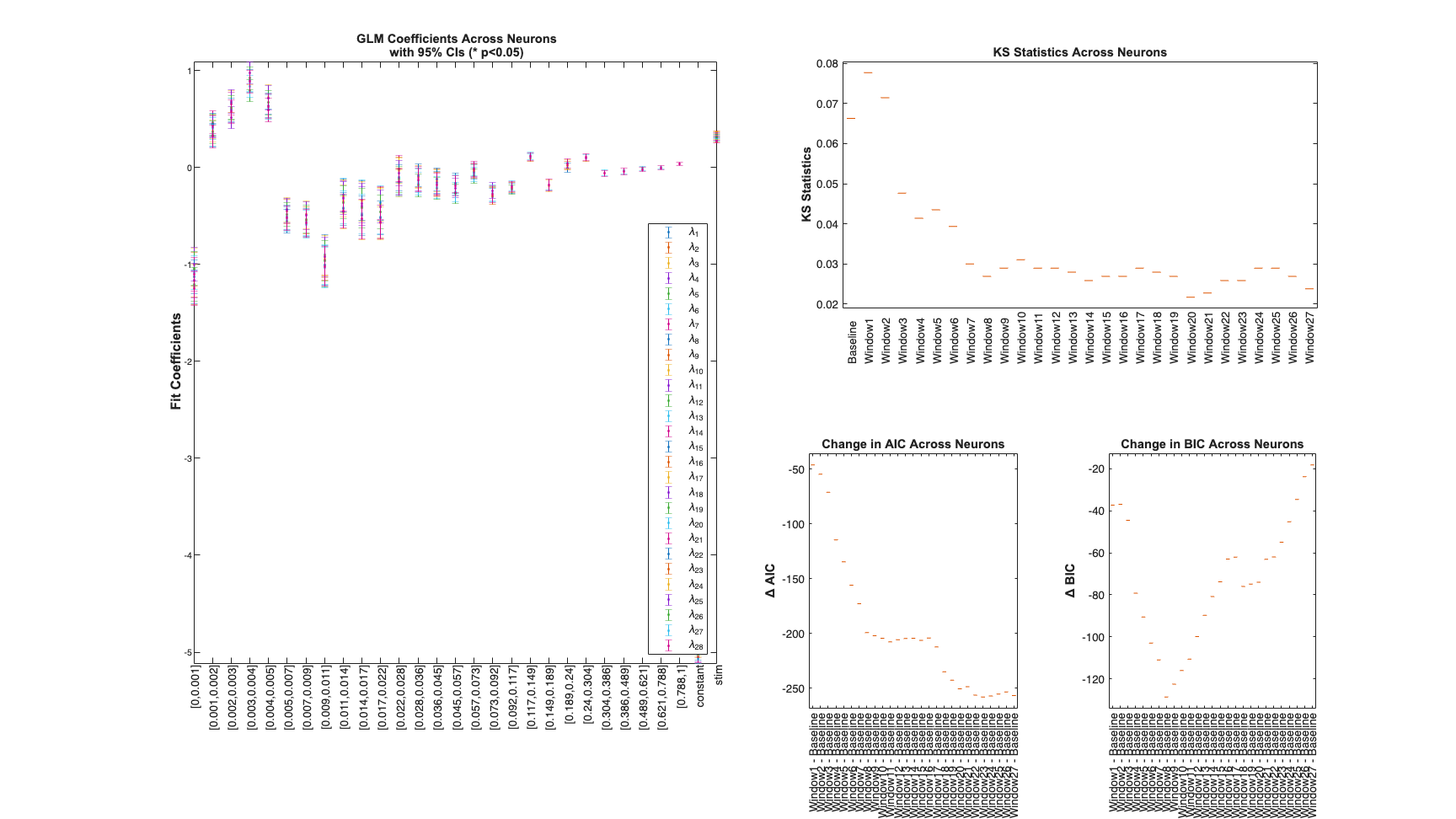
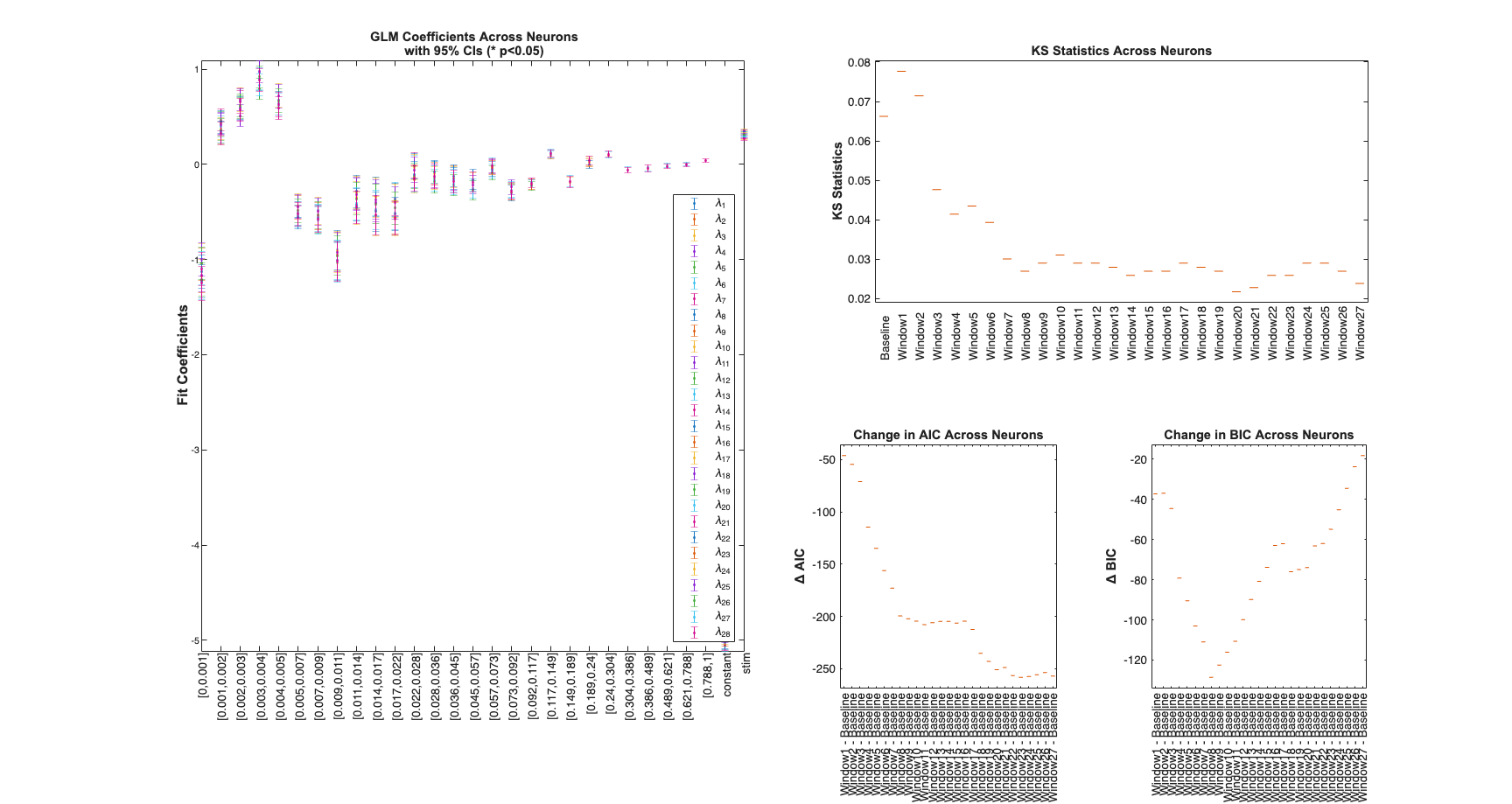
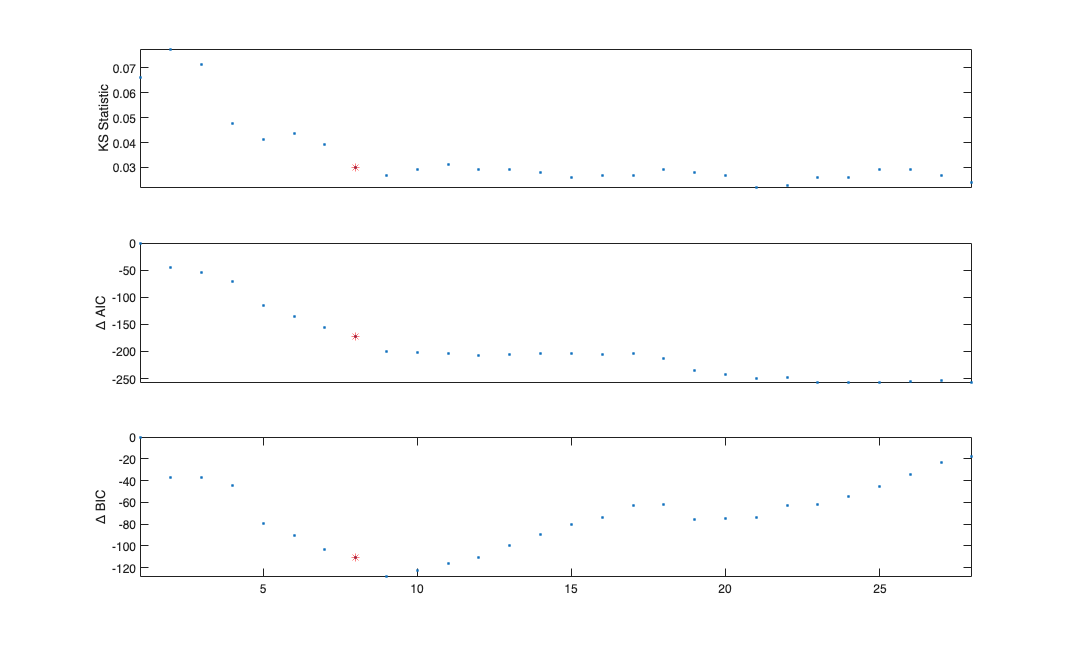
Determine the best history effect model using AIC, BIC, and KS statistic
sampleRate=1000;
delta=1/sampleRate*1;
maxWindow=1; numWindows=30;
windowTimes =unique(round([0 logspace(log10(delta),...
    log10(maxWindow),numWindows)]*sampleRate)./sampleRate);
results =Analysis.computeHistLagForAll(trial,windowTimes,...
    {{'Baseline','constant'},{'Stimulus','stim'}},'BNLRCG',0,sampleRate,0);

KSind = find(results{1}.KSStats.ks_stat == min(results{1}.KSStats.ks_stat));
AICind = find((results{1}.AIC(2:end)-results{1}.AIC(1))== ...
               min(results{1}.AIC(2:end)-results{1}.AIC(1)));
BICind = find((results{1}.BIC(2:end)-results{1}.BIC(1))== ...
               min(results{1}.BIC(2:end)-results{1}.BIC(1)));
if(AICind==1)
    AICind=inf;
end
if(BICind==1)
    BICind=inf; %sometime BIC is non-decreasing and the index would be 1
end
windowIndex = min([KSind,AICind,BICind]) %use the minimum order model
Summary = FitResSummary(results);
Summary.plotSummary;


clear c;
if(windowIndex>1)
    selfHist = windowTimes(1:windowIndex);
else
    selfHist = [];
end
NeighborHist = []; sampleRate = 1000;
Analyzing Configuration #1: Neuron #1
Analyzing Configuration #2: Neuron #1
Analyzing Configuration #3: Neuron #1
Analyzing Configuration #4: Neuron #1
Analyzing Configuration #5: Neuron #1
Analyzing Configuration #6: Neuron #1
Analyzing Configuration #7: Neuron #1
Analyzing Configuration #8: Neuron #1
Analyzing Configuration #9: Neuron #1
Analyzing Configuration #10: Neuron #1
Analyzing Configuration #11: Neuron #1
Analyzing Configuration #12: Neuron #1
Analyzing Configuration #13: Neuron #1
Analyzing Configuration #14: Neuron #1
Analyzing Configuration #15: Neuron #1
Analyzing Configuration #16: Neuron #1
Analyzing Configuration #17: Neuron #1
Analyzing Configuration #18: Neuron #1
Analyzing Configuration #19: Neuron #1
Analyzing Configuration #20: Neuron #1
Analyzing Configuration #21: Neuron #1
Analyzing Configuration #22: Neuron #1
Analyzing Configuration #23: Neuron #1
Analyzing Configuration #24: Neuron #1
Analyzing Configuration #25: Neuron #1
Analyzing Configuration #26: Neuron #1
Analyzing Configuration #27: Neuron #1
Analyzing Configuration #28: Neuron #1

windowIndex =

     8
figure;
x=1:length(windowTimes);
subplot(3,1,1); plot(x,results{1}.KSStats.ks_stat,'.'); axis tight; hold on;
plot(x(windowIndex),results{1}.KSStats.ks_stat(windowIndex),'r*');

 set(gca,'xtick',[]);
ylabel('KS Statistic');
dAIC = results{1}.AIC-results{1}.AIC(1);
subplot(3,1,2); plot(x,dAIC,'.');
 set(gca,'xtick',[]);
ylabel('\Delta AIC');axis tight; hold on;
plot(x(windowIndex),dAIC(windowIndex),'r*');
dBIC = results{1}.BIC-results{1}.BIC(1);
subplot(3,1,3); plot(x,dBIC,'.');
ylabel('\Delta BIC'); axis tight; hold on;
plot(x(windowIndex),dBIC(windowIndex),'r*');

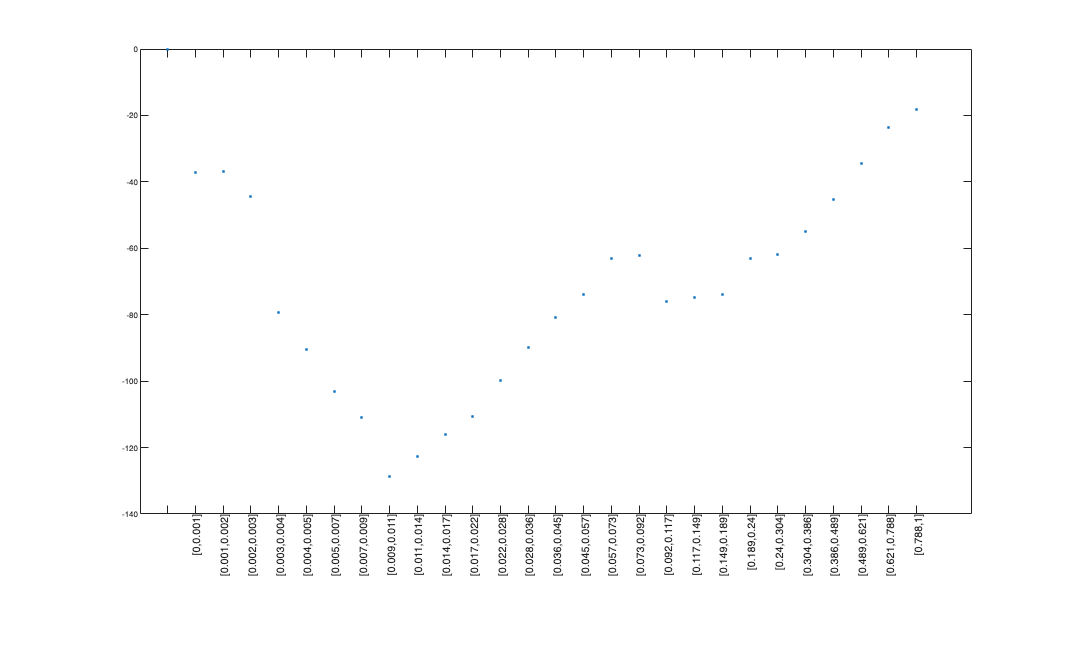
for i=2:length(x)
   histLabels{i} = ['[' num2str(windowTimes(i-1),3) ',' num2str(windowTimes(i),3) ,']'];
end

figure;
plot(x,dBIC,'.');
xticks = 1:(length(histLabels));
set(gca,'xtick',xticks,'xtickLabel',histLabels,'FontSize',6);
if(max(xticks)>=1)
    xticklabel_rotate([],90,[],'Fontsize',8);
end
Compare Baseline, Baseline+Stimulus Model, Baseline+History+Stimulus
Addition of the history effect yields a model that falls within the 95% CI of the KS plot.
c{1} = TrialConfig({{'Baseline','constant'}},sampleRate,[],NeighborHist);
c{1}.setName('Baseline');
c{2} = TrialConfig({{'Baseline','constant'},{'Stimulus','stim'}},...
                    sampleRate,[],[]);
c{2}.setName('Baseline+Stimulus');
c{3} = TrialConfig({{'Baseline','constant'},{'Stimulus','stim'}},...
                    sampleRate,windowTimes(1:windowIndex),[]);
c{3}.setName('Baseline+Stimulus+Hist');
cfgColl= ConfigColl(c);
results = Analysis.RunAnalysisForAllNeurons(trial,cfgColl,0);
results.plotResults;
Analyzing Configuration #1: Neuron #1
Analyzing Configuration #2: Neuron #1
Analyzing Configuration #3: Neuron #1