Contents
Test History
Generete a nspikeTrain and define a set of history windows of interest. We desire windows from 1-2ms, 2-3ms, 3-5ms, and 5ms-10ms. The history object with this windows in created below and then the
spikeTimes = sort(rand(1,100))*1;
nst        = nspikeTrain(spikeTimes,'n1',.001);
windowTimes = [.001 .002 .004];
h=History(windowTimes);
/
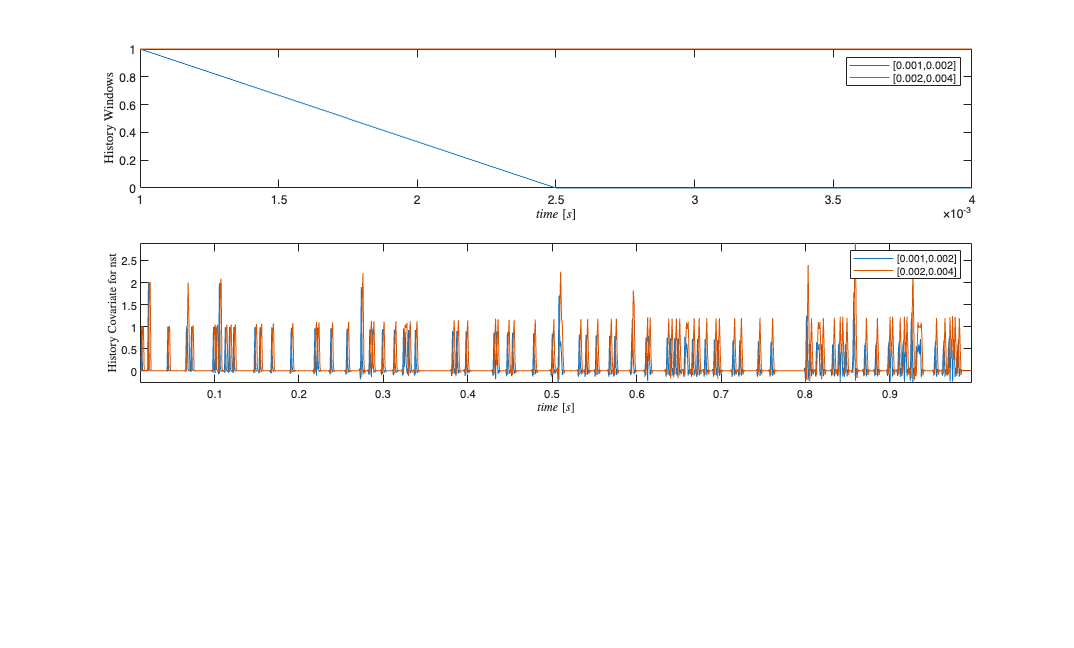
The firing activity within each window is computed by calling the computeHistory method on a nspikeTrain, nstColl, or a cell array of nspikeTrains
histn1=h.computeHistory(nst);
figure; subplot(3,1,1); h.plot; ylabel('History Windows');
subplot(3,1,2); histn1.plot;    ylabel('History Covariate for nst');
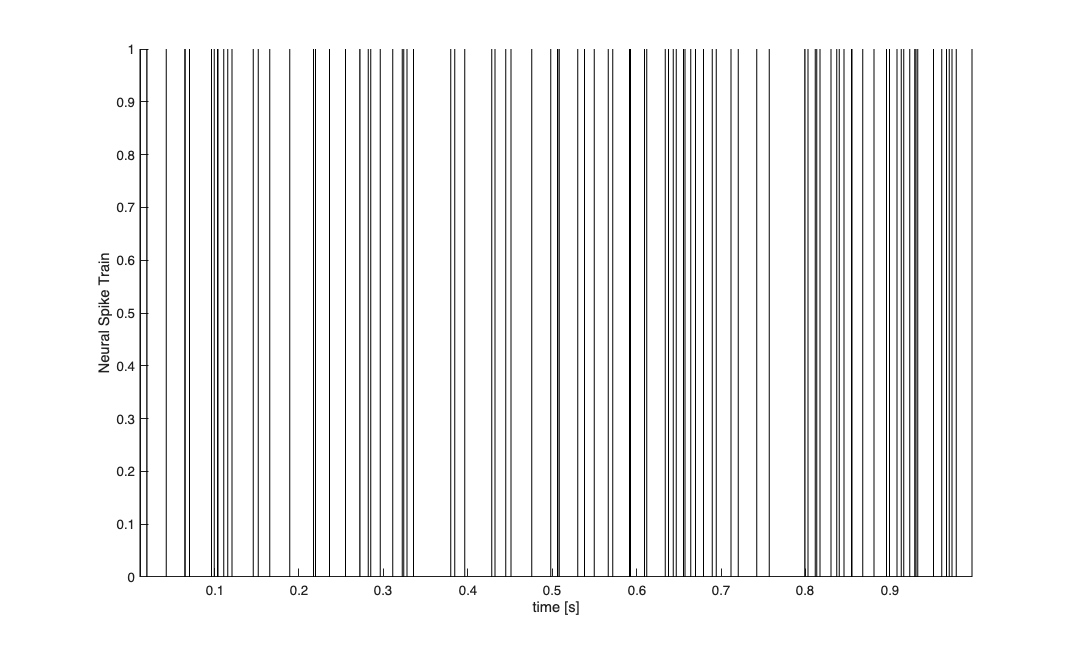
figure; nst.plot;               ylabel('Neural Spike Train');
Example 2: History covariates for a collection of Neural Spikes (nstColl)
It is possible to compute history covariates for all the nspikeTrains in a nstColl simultaneously.
Generate data and create a nstColl
clear nst;
for i=1:1
    spikeTimes = sort(rand(1,100))*1;
    nst{i}=nspikeTrain(spikeTimes,'',.001);
    %nst{i}.setName(strcat('Neuron',num2str(i)));
end
spikeColl=nstColl(nst);

windowTimes = [.001 .002 .01];
h=History(windowTimes);
generate a CovColl (collection of covariates) by applying the computing the history of the entire nstColl
histColl = h.computeHistory(spikeColl);
figure; histColl.plot;