Rhythmic firing and the clinical microelectrode
Goal of this page. Two ideas the other Concepts pages leave implicit. First, rhythmic (oscillatory) firing — neurons that fire to their own beat, not just to a stimulus — and how nSTAT models it with the same point-process GLM you already know. Second, the setting where this matters most concretely: a microelectrode advanced into a deep brain nucleus, the kind of recording made to guide deep brain stimulation (DBS) surgery. The same
nspikeTrain,Analysis,FitResult, andSignalObjtools carry over unchanged; only the application is new.Glossary jumps: rhythmic / oscillatory cell · tremor cell · DBS · microelectrode mapping · beta band · adaptive DBS · multitaper · spectrogram · PPAF
Rhythmic firing: when a neuron has its own beat
Most of this track models firing that is driven from outside — a stimulus, a position, a movement. But many neurons carry an intrinsic rhythm: their firing probability rises and falls periodically even with no changing stimulus. The cleanest clinical example is a tremor cell — a neuron whose firing is phase-locked to a few-hertz limb tremor — first characterized in the human subthalamic nucleus and thalamus during functional neurosurgery (Levy et al. 2000; Hutchison et al. 1998).
A rhythm is not a new kind of model — it is a covariate. If a neuron’s rate oscillates at frequency \(f\), then a pair of sine/cosine regressors at \(f\) (or a band-limited drive) enters the conditional intensity exactly like any stimulus:
That is an ordinary point-process GLM (Truccolo et al.
2005), so nSTAT fits it with the
machinery from the GLM page: a Covariate for the
rhythmic drive, a TrialConfig, and Analysis / fit_poisson_glm. The
spike-history term matters here too — rhythmicity and refractoriness both
live in how a spike changes the probability of the next one.
import numpy as np
from nstat import fit_poisson_glm, population_time_rescale

# A rhythmic cell observed for 60 s at 1 kHz; tremor ~5 Hz.
dt, f = 0.001, 5.0
t = np.arange(0.0, 60.0, dt)
drive = np.sin(2 * np.pi * f * t)                 # the rhythmic covariate

# (spikes y come from your sorter; see the walkthrough script for a simulator)
# Two competing encoders: rhythm-aware vs. constant-rate.
offset = np.full(t.size, np.log(dt))
fit = fit_poisson_glm(drive[:, None], y, offset=offset, l2=1e-4)
lam_rhythm   = np.exp(fit.intercept + fit.coefficients[0] * drive + offset)
lam_constant = np.full_like(y, y.mean())
Did the rhythm model actually fit? The KS test decides
A constant-rate model and a rhythm-aware model can report the same mean rate, yet only one reproduces the timing. The time-rescaling KS test (Brown et al. 2002) is what tells them apart: the constant model leaves the confidence band, the rhythm-aware model stays inside it.
gof_rhythm   = population_time_rescale([y], [lam_rhythm])
gof_constant = population_time_rescale([y], [lam_constant])
# gof_rhythm.ground_ks_pvalue  -> large  (consistent with the model)
# gof_constant.ground_ks_pvalue -> tiny  (rejected: it gets the beat wrong)
This is the honest discipline the whole track returns to: matching the average
firing rate is necessary but not sufficient — only goodness-of-fit certifies
that the model captured the rhythm. The runnable
clinical_microelectrode_walkthrough.py
plays this contrast out end to end on a simulated tremor cell.
The clinical microelectrode: an electrode on a journey
In DBS surgery a microelectrode is lowered millimetre by millimetre toward a deep target — most often the subthalamic nucleus (STN) for Parkinson’s disease, or the globus pallidus or thalamus. The recording team listens and watches the spiking change as the tip passes through successive structures, because each nucleus has a characteristic electrophysiological signature. The STN, for instance, shows a marked rise in firing rate and burstiness on entry — a mean rate near 37 Hz with an irregular, bursty pattern, against a quieter background above (Hutchison et al. 1998). Tremor cells and movement-responsive cells appear within it; the substantia nigra below fires faster and more regularly. Everything on this page is the same nSTAT analysis you have already met, applied to that descent.
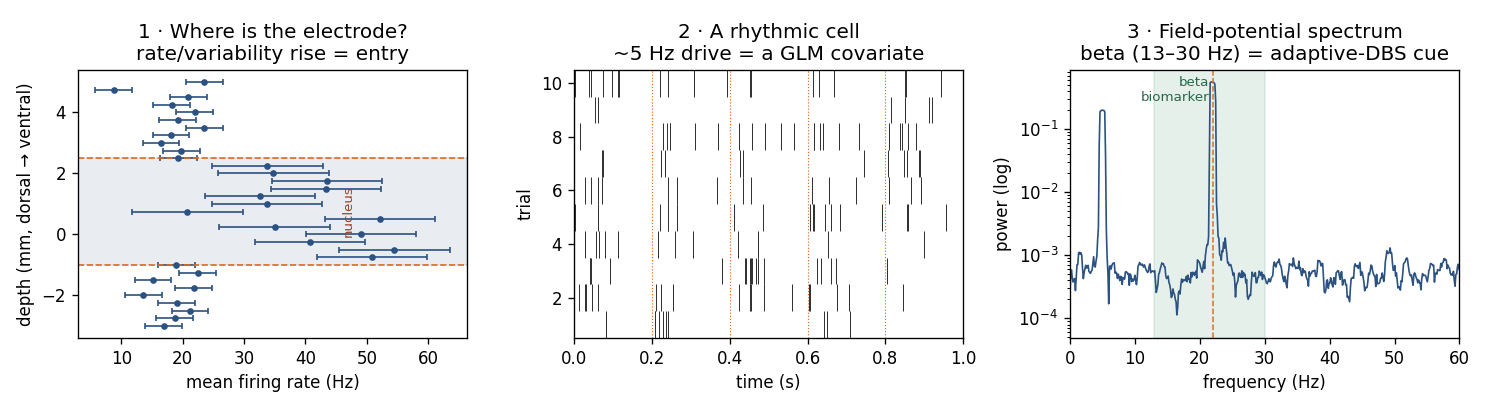
The three analyses this page connects, all from simulated data: (1) firing
rate vs. depth — the localization cue, a latent-state problem; (2) a
rhythmic cell — a point-process GLM with a periodic covariate; (3) the
field-potential spectrum via SignalObj.MTMspectrum, with the beta band that
guides adaptive DBS.
“Where is the electrode?” is a state-estimation problem
Tracking which structure the tip currently sits in — from a running summary of
firing rate, variability, and spectral power that shifts at each boundary — is
naturally a latent-state estimation problem. nSTAT supplies the estimators:
a DecodingAlgorithms.kalman_filter for a continuous depth/state read out of a
Gaussian summary signal, and the point-process filters below for reading state
directly from spikes. The boundaries themselves (entry/exit of a nucleus) are a
change-point on that latent track — the within-recording, evolving-state setting
of the state-space and EM page. The spatial extent of the oscillatory
territory a trajectory crosses is not a curiosity, either: the length of the
dorsolateral beta-oscillatory region predicts how well DBS will work
(Zaidel et al. 2010).
The beta rhythm in the field potential — a biomarker you can spectrum
Low-pass the same electrode and the local field potential carries a population rhythm of direct clinical interest: beta-band (13–30 Hz) activity in the STN scales with Parkinsonian motor impairment and is the feedback signal for adaptive (closed-loop) DBS, which stimulates only when beta is high (Little et al. 2013; Tinkhauser et al. 2017). Estimating that beta power is exactly the multitaper spectrum from the LFP page:
from nstat import SignalObj

lfp = SignalObj(t_lfp, x_lfp, name="STN field potential")
freqs, power, _ = lfp.MTMspectrum(NW=4.0)        # low-variance PSD
beta = (freqs >= 13) & (freqs <= 30)
beta_power = power[beta].sum()                    # the adaptive-DBS feature
Tinkhauser et al. showed the clinically relevant quantity is not even the
average — it is the burst structure: beta arrives in transient bursts, and
longer bursts track worse motor state. A SignalObj.spectrogram (sliding
multitaper) is the right tool to see that time structure that a single spectrum
hides.
Applying nSTAT — reading directly from spikes. When you want the latent state (tremor phase, a movement intention) from the spikes rather than the field potential, the point-process adaptive filter (
DecodingAlgorithms.PPDecodeFilterLinear; Eden et al. 2004) is the spiking analogue of the Kalman filter, and it returns a calibrated credible band — the kind of honest uncertainty a clinical read-out should carry. The closed-loop DBS systems above are, in control-theoretic terms, exactly a decode-then-actuate loop (Little et al. 2013).
Where these recordings come from
nSTAT consumes spike times and sampled field potentials, not raw
acquisition files. Intraoperative and research microelectrode systems write
vendor formats (Spike2, Blackrock, Plexon, NEX, TDT, …); the
nstat.extras.interop.neo bridge reads them through
Neo and hands you the spike
trains and signals to wrap in nspikeTrain / SignalObj. Detection and spike
sorting happen upstream (see Microelectrode
recordings); nSTAT begins once you have sorted
units and an LFP.
Check your understanding
A neuron fires in time with a 5 Hz tremor, with no changing stimulus. How do you represent that rhythm in a point-process GLM, and which nSTAT object holds it?
Your rhythm-aware model and a constant-rate model report the same mean firing rate. What single test separates them, and which one passes?
You want the beta-band biomarker that drives adaptive DBS from a field potential. Which
SignalObjmethod do you call, and why prefer it over a raw periodogram?
Show answers
Add a periodic covariate at the tremor frequency — a
sin/cospair (or a band-limited drive) — as aCovariate, exactly like any stimulus term; include a history term too, since rhythm and refractoriness both live in spike-to-spike dependence. Fit withAnalysis/fit_poisson_glm.The time-rescaling KS test (
population_time_rescale/FitResult.computeKSStats). The rhythm-aware model stays inside the KS band; the constant-rate model is rejected because it matches the mean but gets the timing wrong.SignalObj.MTMspectrum(multitaper), then sum power in 13–30 Hz. Multitaper has far lower variance and controlled leakage than the periodogram, so the beta estimate is stable; useSignalObj.spectrogramif you also need the burst time-structure.
See also
Runnable capstone (simulated, no download):
examples/tutorials/clinical_microelectrode_walkthrough.py— a tremor cell from encode → KS check → beta spectrum → phase decode.Concepts: Spike trains & GLMs · LFP & spectral analysis · Goodness-of-fit & decoding
API:
Covariate,Analysis,fit_poisson_glm,FitResult,SignalObj(MTMspectrum,spectrogram),DecodingAlgorithmsin the API reference