Uncertainty and confidence intervals
Goal of this page. Every number an analysis produces — a tuning coefficient, a firing rate, a decoded position — is an estimate from finite, noisy data. This page shows how nSTAT quantifies that uncertainty, and why an estimate without an interval is only half an answer.
Glossary jumps: GLM · CIF · link function · PPAF · SSGLM
Why a point estimate is not enough
Suppose you fit a GLM and find a stimulus coefficient of \(\beta_1 = 1.55\). Is the neuron really stimulus-driven? It depends entirely on the uncertainty: if the 95% confidence interval is \(1.55 \pm 0.10\) the effect is solid; if it is \(1.55 \pm 0.80\) you have learned almost nothing. The same estimate supports opposite conclusions depending on its interval. Reporting estimates without intervals is the single most common way a spike-train analysis overstates what the data show.
Uncertainty has one reliable cure: more (and more informative) data. As a recording lengthens, the Fisher information accumulates and the interval shrinks around the truth.
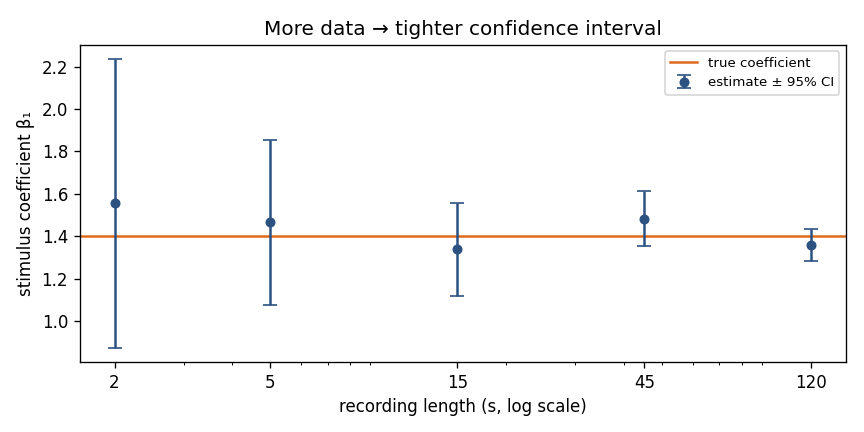
The same neuron, analyzed from progressively longer recordings. Each estimate (blue) brackets the true coefficient (orange) with its 95% interval, and the interval narrows steadily with data. With only 2 s the data are consistent with a wide range of tuning strengths; by 120 s the coefficient is pinned down.
Uncertainty in a GLM coefficient
For a point-process / Poisson GLM, the uncertainty of the fitted coefficients comes from the Fisher information — the curvature of the log-likelihood at the optimum. Sharply curved (well-identified) parameters have small standard errors; flat directions have large ones. For the Poisson GLM with design matrix \(X\) and fitted per-bin intensity \(\lambda\), the information matrix and standard errors are
In Python:
import numpy as np
from nstat import fit_poisson_glm

fit = fit_poisson_glm(X, y, offset=offset)
lam = fit.predict_rate(X, offset=offset)         # fitted intensity per bin

Xaug   = np.column_stack([np.ones(len(y)), X])    # include the intercept column
fisher = Xaug.T @ (lam[:, None] * Xaug)           # Xᵀ diag(λ) X
cov    = np.linalg.pinv(fisher)                   # parameter covariance
se     = np.sqrt(np.diag(cov))                    # standard errors

# 95% confidence interval for each coefficient:
beta   = np.concatenate([[fit.intercept], fit.coefficients])
ci_low, ci_high = beta - 1.96 * se, beta + 1.96 * se
A coefficient whose CI excludes 0 is “significant” at the 5% level; one whose CI straddles 0 is not distinguishable from no effect. The worked model-comparison tutorial uses exactly this recipe to report every coefficient with its interval.
Watch the link function. These intervals are on the log-rate scale (the GLM’s linear predictor). To get an interval on the firing rate itself, transform the endpoints through \(\exp(\cdot)\) rather than adding a symmetric band to \(\exp(\beta)\) — the rate interval is asymmetric.
Uncertainty in a firing-rate curve
When you want a confidence band around a whole firing-rate estimate (a PSTH,
a tuning curve, a place field), nSTAT provides
DecodingAlgorithms.computeSpikeRateCIs, and computeSpikeRateDiffCIs for the
difference between two conditions (e.g. stimulus vs. baseline). The bounds
come back as a ConfidenceInterval object, which stores the lower/upper traces
on a shared time axis and knows how to plot itself as a line pair or a shaded
band.
Uncertainty in a decode
Decoding is estimation too, so a decode also carries uncertainty. The point-process adaptive filter (PPAF) propagates a posterior covariance \(W_k\) alongside the state estimate \(x_k\): the square root of its diagonal is the familiar 95% credible band around the decoded trajectory.
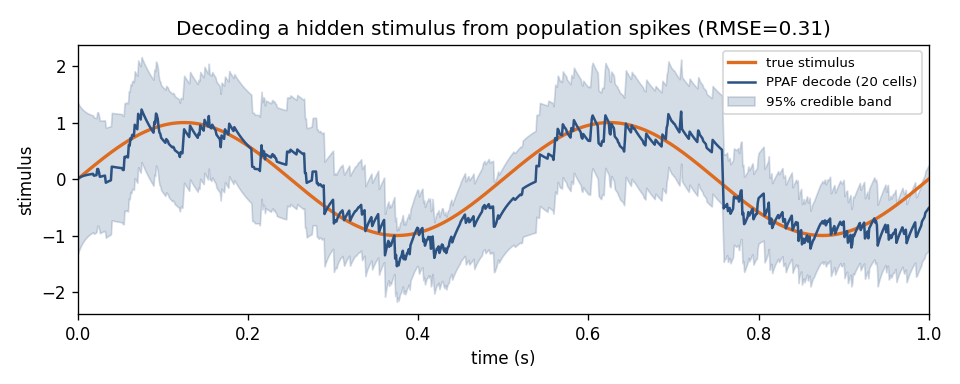
The decode (blue) tracks the true stimulus (orange); the shaded band is the
filter’s own 95% credible interval. The band widens when spikes are sparse and
tightens when the population is informative. For the across-trial SSGLM,
DecodingAlgorithms.ComputeStimulusCIs builds the matching intervals (by Monte
Carlo for the full cross-trial covariance, or a Gaussian z-score approximation
for a smoother’s output).
Check your understanding
Two neurons both have stimulus coefficient \(\beta_1 = 0.8\), but neuron A’s 95% CI is
[0.6, 1.0]and neuron B’s is[-0.3, 1.9]. Which neuron is convincingly stimulus-driven?You halve your recording length. Roughly what happens to the width of a coefficient’s confidence interval?
Why is a 95% interval on a firing rate asymmetric even though the interval on the log-rate coefficient is symmetric?
Show answers
Neuron A. Its interval excludes 0, so the effect is reliably positive. Neuron B’s interval straddles 0 — the data are consistent with no stimulus effect at all, despite the identical point estimate.
It roughly grows by \(\sqrt{2}\) (≈ 41% wider). Standard errors scale like \(1/\sqrt{\text{information}}\), and information accumulates with data, so halving the data multiplies the interval width by about \(\sqrt{2}\).
The rate is \(\exp(\beta)\), a nonlinear transform. Pushing the symmetric endpoints \(\beta \pm 1.96 \cdot \mathrm{se}\) through \(\exp(\cdot)\) stretches the upper side more than the lower, giving an asymmetric rate interval. Transform the endpoints, never add a symmetric band to \(\exp(\beta)\).
See also
Worked tutorial reporting coefficients with 95% CIs from the Fisher information —
examples/tutorials/model_comparison.pyGoodness-of-fit and decoding — the credible band on a decode comes from the same posterior covariance.
API:
DecodingAlgorithms.computeSpikeRateCIs,DecodingAlgorithms.computeSpikeRateDiffCIs,DecodingAlgorithms.ComputeStimulusCIs,ConfidenceInterval.Common pitfalls & FAQ — other ways an analysis can quietly mislead.