State-space models: learning dynamics and EM
Goal of this page. Go beyond the static encoding GLM to models whose parameters change over time — across trials as an animal learns, or within a trial as a latent brain state evolves. These are state-space models, fit by the EM algorithm.
Glossary jumps: SSGLM · GLM · CIF · Kalman filter / smoother · PPAF · hybrid PP filter (PPHF)
This page assumes the point-process GLM and the decoding pages.
Why a state space?
The GLM on the spike-trains page assumes a neuron’s tuning is fixed for the whole recording. That is often false:
During learning, the stimulus→firing relationship changes trial by trial.
Within a trial, an unobserved latent state (attention, motor plan, position) drives firing and itself evolves smoothly in time.
A state-space model has two layers:
A state equation describing how a hidden state \(x_t\) evolves (e.g. a random walk \(x_t = A \, x_{t-1} + \text{noise}\)).
An observation equation linking the state to what we measure — here, spikes via a point-process GLM whose parameters depend on \(x_t\).
The job is to estimate the trajectory of the hidden state (and the model parameters) from the spikes alone.
Two flavors in nSTAT
1. Across-trial learning — the state-space GLM (SSGLM). The GLM coefficients themselves become the latent state and are allowed to drift from trial to trial. This captures plasticity: how tuning sharpens or shifts as the animal learns. The estimator is an expectation–maximization (EM) algorithm with a forward–backward (Kalman) smoother over trials (Smith & Brown 2003). In nSTAT:
# population is an nstColl of spike trains, one per trial/neuron;
# cfg is a TrialConfig as on the GLM page.
result = population.ssglm(...)      # forward filter
result = population.ssglmFB(...)    # forward-backward smoother (recommended)
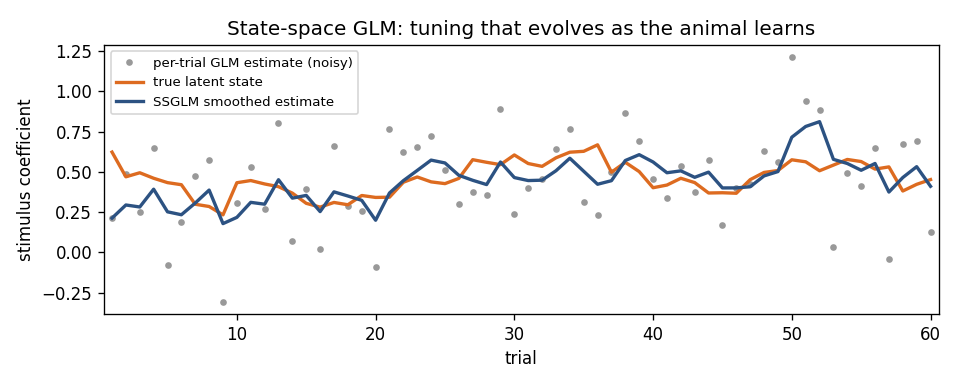
Why a state space helps: the true tuning (orange) drifts as the animal learns. Fitting each trial independently is noisy (grey); the SSGLM smoother (blue) borrows strength across trials to recover the trajectory.
Paper Example 03 walks through SSGLM end to end on PSTH-style data.
2. Within-recording latent state — adaptive filtering / EM-trained SSMs. When the latent state evolves within a recording, you either (a) decode it online with the point-process adaptive filter (the decoding page; Eden et al. 2004), or (b) learn the state-space model’s parameters with EM when they are unknown.
For (b), the opt-in nstat.extras.em.dynamax_bridge provides modern
EM trainers for linear-Gaussian, point-process, and hybrid state-space models
(the KF_EM / PP_EM / mPPCO_EM family), built on Dynamax (JAX). It adds
held-out predictive log-likelihood for honest model comparison and a
multi-restart workflow that is the recommended way to fit on real data:
from nstat.extras.em.dynamax_bridge import fit_point_process_em_best_of

result = fit_point_process_em_best_of(
    spike_counts, state_dim=3, n_restarts=8, holdout_fraction=0.2,
    init="log_empirical_rate",   # data-driven initialization
    ridge_lambda=0.5,            # stabilizes the transition estimate
)
result.best_predictive_ll        # held-out log-likelihood of the winner
Why multi-restart + held-out scoring? EM finds a local optimum, and point-process state-space EM has a weak-observability failure mode where the transition collapses. Fitting several random restarts and keeping the one with the best held-out predictive log-likelihood avoids reporting a degenerate fit. See the EM extras guide for the full caveats.
Applying nSTAT — the electrode descent as an evolving latent state. Both flavors above have a clinical reading. The intraoperative microelectrode descent is a within-recording latent state: as the tip advances, the structure it sits in changes, and the firing-rate / variability / spectral summary jumps at each nucleus boundary — a change-point on a latent depth-region track that the state-space estimators here are built to follow (Hutchison et al. 1998; Zaidel et al. 2010). The across-trial SSGLM has the longitudinal analogue: a coefficient that drifts as an animal learns is the same machinery you would use to track a slowly evolving disease or therapy-response state across sessions. See Rhythmic firing and the clinical microelectrode.
A note on networks and causality
The same statistical machinery underlies functional connectivity. Ensemble
terms in the GLM (the spike-trains page) already capture one neuron’s influence
on another. For directed, frequency-resolved interactions between continuous
signals (e.g. LFP channels), nSTAT’s Analysis provides Granger causality
over an ensemble — the continuous-signal analogue of the coupling terms in the
point-process GLM.
Check your understanding
When would you choose the state-space GLM over a plain (static) GLM?
Why does point-process EM (
PP_EM) use multiple restarts with held-out scoring instead of a single fit?
Show answers
When the tuning changes over time — e.g. across trials as the animal learns or adapts. The SSGLM lets the coefficients evolve as a latent state.
EM converges only to a local optimum and point-process state-space EM has a collapse failure mode. Several restarts scored by held-out predictive log-likelihood pick a non-degenerate fit.
See also
Runnable example: SSGLM across-trial dynamics — Paper Example 03
examples/paper/example03_psth_and_ssglm.pyEM trainers (opt-in): the EM extras guide and
examples/extras/em_dynamax_demo.pyNotebooks:
AnalysisExamples2.ipynb,HybridFilterExample.ipynbAPI:
nstColl.ssglm/ssglmFB,DecodingAlgorithms,nstat.extras.em.dynamax_bridgein the API reference